Petit Lenormand combinations

Child and Mice

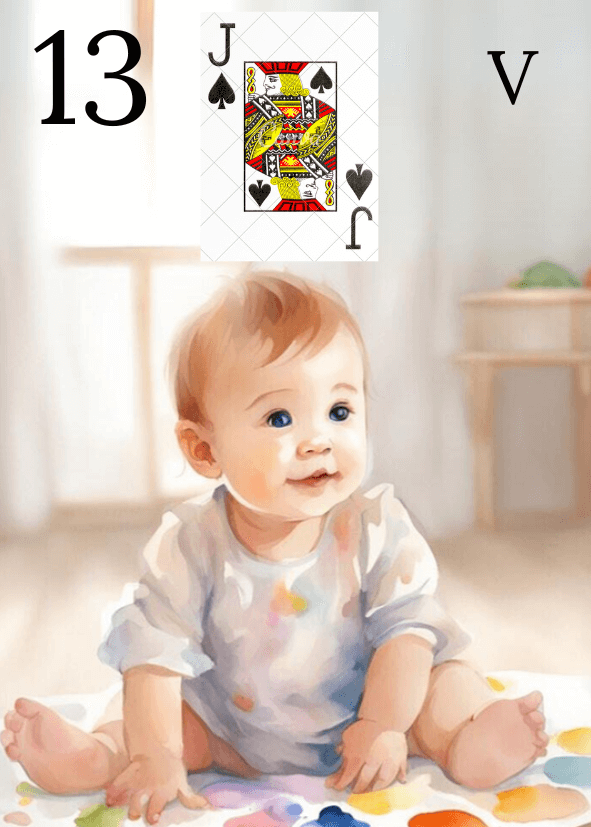
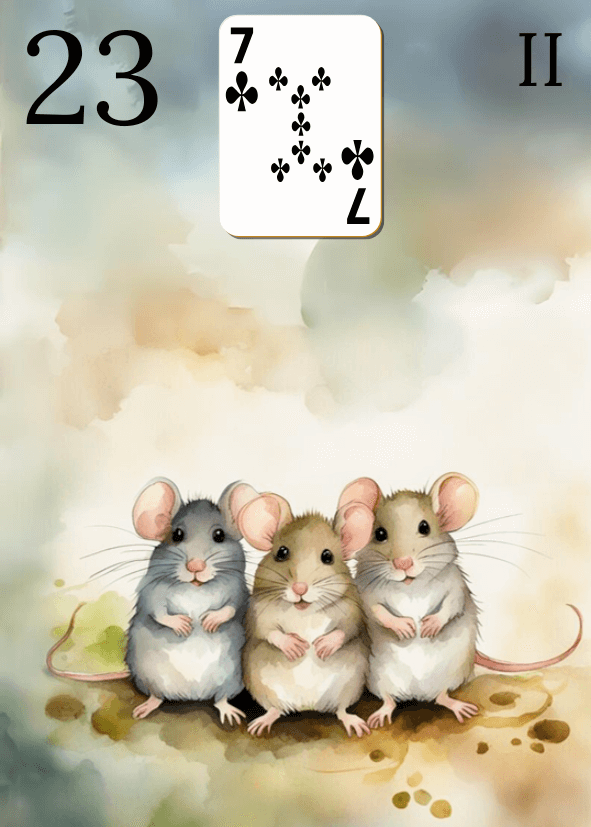
Here you see the two possible orders of the pair Child and Mice. On the left, Child acts on Mice. On the right, Mice sets Child in motion. The concrete scenes help you feel what shifts as soon as the order shifts.

Combination
13 Child → 23 Mice

General meaning

A young momentum or a nascent situation is gradually undermined by small losses and a climate of worry.

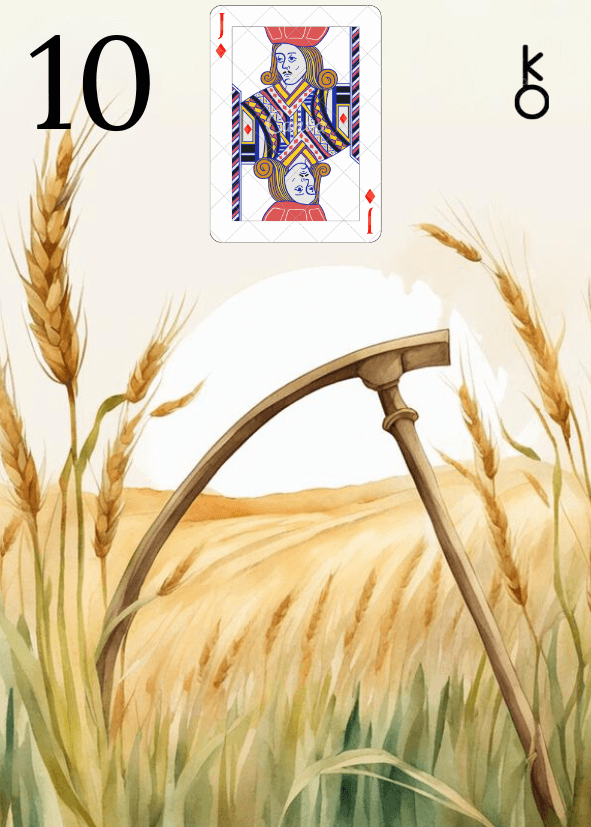
The Child symbolizes the beginning, innocence, a fresh perspective, and learning through experience. The Mice introduce a slow erosion, minor but repetitive concerns, nervous fatigue, and the feeling that something is gradually being lost. Together, these cards describe a fragile start confronted with conditions that undermine it before it has even had time to assert itself. The Cross, in quintessence, reminds us that the real issue is not only material but existential: how to maintain self-confidence and faith in life when the first steps are immediately besieged by doubt and fear of inadequacy? The Scythe, in the occult, indicates that at some point, it will be necessary to clearly cut away what drains the momentum, whether it be a habit, an environment, or a mindset that damages the freshness of the start.

Love and relationships

In love, a young bond or a new way of loving is weakened by recurring small fears.

On the emotional level, the Child and the Mice can refer to a relationship that is just beginning and is already exposed to worries, light jealousies, doubts, or insecurities. This can also evoke a dynamic where one partner feels emotionally very young or vulnerable and is gnawed at by the fear of not being enough, not performing well, or losing the other at the slightest misstep. In a family context, this combination can also signal a child or teenager who senses a climate of tension, perceiving the worries of adults without always understanding them. The Cross emphasizes that these small accumulated wounds leave a deep mark if they are not acknowledged. The Scythe, in the background, suggests that sooner or later it will be necessary to cut away devaluing remarks, habits of criticism, or an overly anxiety-inducing environment to allow love to remain a space for growth and not a ground for anxiety.

Work and vocation

In work, a beginning or junior position is tested by a series of incessant small pressures.

On a professional level, this combination can describe a newly obtained position, an internship, a trial phase, or a new role where one still feels in a learning process. Mice add a layer of daily stress: small mistakes that waste time, urgent requests, nitpicking remarks, diffuse mental load, and the impression of never doing enough. The Child reminds us that we are supposed to learn, make mistakes, and experiment; however, the environment or organization can create the feeling that every detail counts as a serious fault. The Cross shows that this pressure deeply affects self-esteem and can lead to a form of early fatigue regarding work. The Scythe, in the background, indicates that it may become necessary to set clear boundaries, reorganize the workload, or, in some cases, withdraw from a context that quickly damages trust in one's abilities.

Money and material security

Financially, the combination speaks of small amounts that are lost, a fragile start, and anxiety about lack.

On a material level, the Child evokes first earnings, a small savings, a still modest budget, or a developing relationship with money. The Mice symbolize leaks, unexpected expenses, and small repetitive costs that nibble away at the account without knowing exactly where everything has gone. This can correspond to a situation where one always feels a bit below the safety threshold, as if money disappears faster than it arrives. The Cross, in essence, emphasizes that this feeling of insecurity is not just financial; it awakens older fears of deprivation or lack. The Scythe evokes the necessity of decisive action to stop the hemorrhage: reviewing a subscription, cutting a toxic expense, exiting an unfair arrangement, or setting very clear limits on what benefits from your financial naivety.

Health and energy

For health, a sensitive terrain or still young energy is undermined by repetitive stress and nervous wear.

In terms of health, the Child can show a developing organism, a delicate nervous system, or a phase of convalescence where everything remains fragile. The Mice refer to the tension that accumulates, to sleep being eroded, to small symptoms multiplying, and to the underlying anxiety that gnaws at energy. One thinks, for example, of a child or a sensitive person who somatizes family worries, or someone who starts a new lifestyle and quickly feels overwhelmed by daily micro-stresses. The Cross, in essence, reminds us that if nothing changes, this wear can transform into a real physical or moral trial. The Scythe, in the background, indicates that a clear stop, a break from a harmful context, or a radical change in habits or acquaintances may become essential to protect what is still being built.

Objects

The objects evoke small concrete elements that testify to this silent erosion from the beginning.

  • Exercise book or progress notebook half-filled, abandoned due to lack of support or because of repeated criticism
  • Modest but numerous bills, bank statements showing a series of small expenses that eventually weigh down
  • Toys or work tools damaged by use or neglect due to lack of a protective framework
  • Alert letters or reminders for small amounts that reinforce a feeling of insecurity
  • Notes, lists, or reminders that testify to a constant worry around a project or a child

Places

The associated places are often spaces where one should be able to learn safely, but where the atmosphere is charged with micro-tensions.

This combination can point to a school, a daycare, a leisure center, a training or internship environment where people at the beginning of their journey do not feel truly protected. It can also be a cramped, noisy, or poorly suited housing where a young child or a new project struggles to flourish. The Child reminds us of the initial intention: a space for discovery, play, and progression. The Mice show the daily reality: fatigue, agitation, small aggressions, and an atmosphere of scarcity or latent stress. The Cross emphasizes the emotional or karmic weight of these places in memory. The Scythe invites us to ask whether it might be time to leave, rearrange, or clearly set conditions for the space to become supportive again instead of gnawing at what is trying to be born.

Personality

The described personality oscillates between naivety and anxiety, with a tendency to feel quickly overwhelmed.

On a psychological level, the Child and Mice can describe someone very sensitive, curious, with great potential but easily overwhelmed by worries and details. This person often starts with enthusiasm, then ends up being gnawed at by the fear of failing, the gaze of others, small remarks, or the pressure of daily life. They may minimize their needs, hesitate to ask for help, or judge themselves harshly for every mistake. The Cross highlights a deeper wound of trust, sometimes old. The Scythe suggests that learning to say no, cutting off sources of unnecessary stress, and surrounding oneself with truly caring people is part of their evolution mission.

Profession

The associated professions touch on both childhood, support for beginnings, and the prevention of psychological wear.

  • Psychologist, therapist, or specialist support for anxious children or young people in stressful situations
  • Teacher attentive to discreet signals of discouragement in students
  • Social worker intervening in families in precarious situations or mental overload
  • Advisor in the prevention of professional burnout among beginners or interns
  • Health professional identifying the impact of chronic stress on the most vulnerable

Archetype

The archetype is that of the inner child who feels gnawed at by worries too great for them.

Symbolically, this combination embodies a part of oneself that simply wants to explore, play, and learn, but finds itself envied, criticized, or pressured by disproportionate demands. The Child represents the desire for innocence and novelty, while the Mice show how small fears, biting remarks, accountability, and repeated lacks gnaw at this spontaneity. The Cross indicates that this dynamic is a true trial of the soul. The Scythe, in the background, reminds us that it is possible, at some point, to end this scenario by cutting off from the situations and beliefs that fuel this premature wear.

Shadow work

The shadow appears when one minimizes the seriousness of what gnaws at them, under the pretext that 'these are just small details.'

In its dark polarity, this combination can lead to trivializing warning signals because they seem tiny when taken in isolation. One tells oneself that it is just stress, minor remarks, or insignificant money leaks, while allowing these elements to undermine the structure of the beginning. The Child then finds itself reduced to 'getting by' in a toxic environment without real support. The Cross shows that what is experienced as a rain of small troubles can, when accumulated, become a heavy burden to bear. The Scythe invites one to recognize the seriousness of the situation and to accept cutting short, even if it seems abrupt to those who only perceive the surface.

Calibration questions

The questions help to identify what is quietly gnawing at your beginnings and the confidence that accompanies them.

  • In which area of your life do you feel that a project or a part of you is being gradually nibbled away?
  • What small sources of stress or loss are you minimizing while they are deeply exhausting you?
  • What clear cut could you make to protect your budding momentum and your sense of innocence?
Combination
23 Mice → 13 Child

General meaning

After a phase of slow erosion, life pushes towards a reset that requires accepting the need to become a beginner again.

Mice, in the first position, indicate a time of fatigue, losses, worries, and small repetitive attacks that have depleted reserves. One feels worn out, drained, and sometimes cynical. Child then arrives as an invitation to start over, to simplify, and to accept rebuilding in a humble and gradual manner. Cross, in quintessence, reminds us that this journey is not trivial: it questions how you treat yourself, how you perceive your worth, and how you embrace your own fragilities. Scythe, in the background, indicates that a clear, almost radical change is necessary for the new phase not to be built on the same foundations as the one that has crumbled.

Love and relationships

In love, this combination speaks of a bond worn by worries, which can only restart on a different relational mode, simpler and truer.

In romantic life, Mice and Child can describe a relationship eroded by the tensions of daily life, unspoken issues, material worries, or diffuse jealousies. All of this has gradually diminished spontaneity, humor, and tenderness. Child in the second position suggests either relearning to be together differently, rediscovering play, curiosity, and the ability to marvel at each other, or closing a chapter to open a new bond with someone else, from a lighter heart. In a family context, this combination also highlights the impact of adult worries on children and the necessity to offer them spaces for breathing. Cross emphasizes the seriousness of what has been traversed, while Scythe indicates that the couple or the individual may need to make a clear decision to protect the youngest and most vulnerable part of their way of loving.

Work and vocation

In work, the combination points to weariness that compels one to consider a new beginning, even modest, to regain breath.

Professionally, Mice evoke the overload of files, insidious pressures, lack of recognition, and the small injustices that repeat and ultimately erode the desire to engage. Child shows that at some point, the only healthy way out may be to accept starting over: changing departments, switching careers, resuming training, or working on a more personal project in parallel. This may mean losing a status, a 'level', or a certain self-image, but gaining coherence and mental health. Cross, in essence, highlights the initiatory nature of this stage: the trial forces you to ask what you truly want to serve and how you want to work. Scythe, in the background, indicates that frank, possibly abrupt decisions are preferable to half-measures that would simply prolong the weariness.

Money and material security

Materially, the association invites you to break free from a spiral of small losses to rebuild a simpler and more realistic management.

Financially, Mice speak of emptying accounts, numerous expenses, and small shortages that ultimately create real fatigue. One may conclude that the current lifestyle is unsustainable. Child then suggests returning to basics: reviewing your budget as if learning to manage money for the first time, refocusing on essentials, and adopting clear and easy-to-maintain habits. Cross reminds us that guilt, shame, or feelings of failure can weigh heavily. However, Scythe indicates that a strong gesture, such as closing a harmful spending channel, renegotiating a commitment, or moving to a more affordable setting, can free the necessary space for this new material start.

Health and energy

For health, the combination highlights exhaustion that calls for a form of gentle and progressive rehabilitation.

On the physical and psychological level, Mice show the accumulated effects of lack of rest, anxiety, mental load, and small signals ignored for too long. Child invites you to stop seeking performance but to focus on relearning: rediscovering simple gestures, reintroducing moments of play, stretching, walking, and listening to the body. It may involve physical rehabilitation after a difficult period, or emotional rehabilitation where one learns to treat oneself with the gentleness one would offer a child. Cross in essence emphasizes that the recovery path will not be instantaneous but profound. Scythe in the background indicates that it will be necessary to cut certain rhythms, habits, or obligations for this reconstruction to be real and not merely symbolic.

Objects

The associated objects speak of what marks the transition between weariness and a new beginning.

  • A medical or professional file showing a succession of small alerts before a real stop
  • A notebook or journal where one assesses what is exhausting and sketches out new, simpler benchmarks
  • Basic tools for a new activity, acquired after leaving behind unnecessary equipment
  • Educational books, games, and learning materials that accompany a reorientation or convalescence
  • Symbolic objects of a second chance, such as a new notebook, a first instrument, or a beginner's kit

Places

The places mentioned are those where one arrives after a complicated period to learn to live differently.

This combination may refer to a rehabilitation center, a support structure, a second chance school, or a community space where one regains footing after material or psychological difficulties. It may also refer to a more modest but healthier new home, or a simpler but less toxic work environment. Mice show where one comes from: a context where everything was slowly crumbling. Child shows where one is going: a setting where it is possible to start over, learn, and test without being immediately judged. Cross reminds us of the intensity of this transition. Scythe emphasizes the dimension of a clean break with the old places of weariness, even if it involves renunciations.

Personality

The personality described has gone through a long period of stress and is now seeking to reinvent itself with humility.

This combination may describe someone who has given a lot, endured a lot, who has long let worries gnaw at them, and who ultimately recognizes that this way of living is no longer sustainable. Mice translate their former mode of operation: worrying about everything, compensating, accumulating small concessions, and holding on despite exhaustion. Child represents the new version of themselves trying to emerge: simpler, more authentic, more curious, and less burdened by the fear of judgment. Cross shows that this shift requires courage, as it touches on the very meaning of their life. Scythe indicates that this person benefits from making clear breaks, even if it disappoints certain expectations, to give themselves a real chance to start over.

Profession

The associated professions accompany transitions after weariness, reconstruction, and second chances.

  • Support worker for burnout, retraining, or return to work
  • Life coach or therapist helping to restart after a long period of stress or losses
  • Street educator, intervening in precarious contexts to open new perspectives
  • Manager of second chance schools or professional programs
  • Mediator supporting exhausted families or teams towards a new start

Archetype

The archetype is that of the fragile phoenix that is reborn, not in grandeur, but in the simplicity of a first step.

Symbolically, Mice and Child tell the story of someone who has been worn down by life, by burdens, and by worries, and who understands that they cannot continue like this. They then accept to return to something more elementary, to shed certain roles, and to start at a beginner level, but with a much deeper awareness. Cross indicates that this rebirth is not a whim; it is a necessary passage. Scythe suggests that courage consists of cutting away what prevents this new birth, even if it disrupts structures that have been in place for a long time.

Shadow work

The shadow manifests when one clings to worries out of habit, refusing the simplicity of a new start.

In its most difficult form, this combination can describe a person who, even exhausted, clings to what gnaws at them because the unknown is scarier than weariness. Mice then become a way of life, almost an identity, and the Child remains at the door, perceived as naive or unrealistic. One can mock their own needs for play, joy, and rest in the name of realism. The Cross shows that this posture perpetuates suffering. The Scythe, in the background, invites recognition that turning the page may be healthier than endlessly repairing a structure that no longer holds.

Calibration questions

The questions invite you to concretely consider your own second chance.

  • In which area of your life do you feel that worries have gnawed so much at your energy that it has become necessary to start anew?
  • If you accepted to start at a beginner level, what would you choose to learn or rebuild first?
  • What clear action could you take right now to cut off a source of weariness that has become incompatible with your health and joy?
A wink for advanced readers

Quintessence and the hidden card of the pair

Each combination is carried by a Quintessence that gives the overall direction, and a hidden card that works in the background. These two cards illuminate the scene without replacing the main reading.

Lenormand card 36 Cross
Quintessence

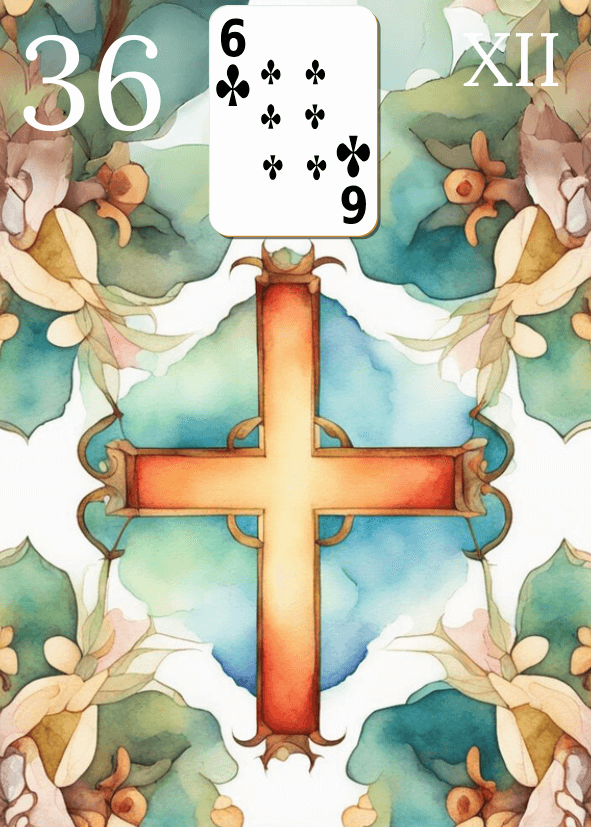
36 Cross

The combination highlights the weight of a trust trial that begins early or at a still fragile stage.

inner trial emotional burden fear of doing wrong
Lenormand card 10 Scythe
Hidden card

10 Scythe

A clear cut must be made to stop what is slowly undermining the beginning of something.

radical decision distance necessary protection