Petit Lenormand combinations

Whip and Anchor

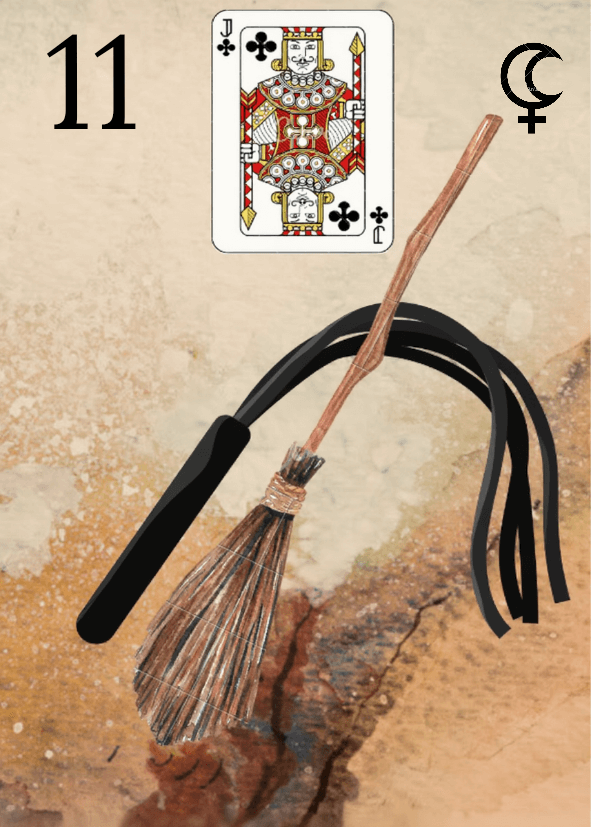
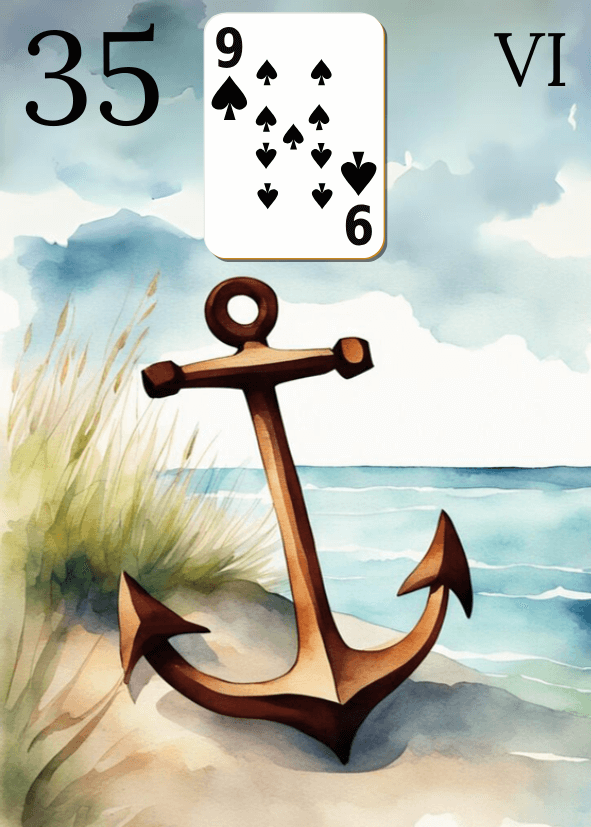
Here you see the two possible orders of the pair Whip and Anchor. On the left, Whip acts on Anchor. On the right, Anchor sets Whip in motion. The concrete scenes help you feel what shifts as soon as the order shifts.

Combination
11 Whip → 35 Anchor

General meaning

A recurring conflict shakes an otherwise anchored situation, as if stability is no longer enough.

The Whip introduces the idea of repetition, tension, and scenes that recur endlessly. Placed with the Anchor, it shows that these frictions occur within a framework that does not move, a well-established life or work structure, but which becomes burdensome. The combination often describes a stability gained at the cost of permanent effort, where security coexists with annoyance, criticism, and the feeling of going in circles. Something holds, but this holding requires regular lashings, as if one must force oneself every day to stay the course.

Love and relationships

The relationship holds strong, but at the cost of repeated disputes that signal an underlying weariness.

On the sentimental level, the Whip and the Anchor evoke a couple firmly established, sometimes for a long time, but crossed by cyclical quarrels. The same subjects come up, the same reproaches, the same disputes over daily organization, task distribution, and time devoted to the relationship. The Anchor shows that the bond itself is stable, that there is a deep attachment, even an emotional or material dependency. The Whip signals that this security is no longer enough to soothe what grates: anger is expressed, sometimes harshly, without really questioning the foundation. This combination reminds us that a solid relationship does not have to rely on fatigue, guilt, or overcontrol.

Work and vocation

Professional stability rests on a hard rhythm, repeated criticisms, or constant pressure.

In the field of work, this combination often speaks of a stable job, a well-established position, a lasting contract, but accompanied by frequent tensions. The Whip can indicate authoritarian management, repeated remarks, stressful evaluations, conflicts between colleagues, or periods of regular overload. The Anchor reminds us that, despite this, one remains in place: the position holds, the structure holds, but the atmosphere wears down. It can also refer to a physical or sports profession where one repeats the same gestures while pushing a little harder each time, risking injury or burnout. The combination raises the question: does what you have built professionally really deserve this level of daily tension?

Money and material security

Material security is maintained, but at the cost of a constant struggle.

Financially, the Whip and the Anchor describe an ability to stay the course, to pay bills, to maintain a minimum of stability, all while feeling constantly under pressure. Expenses, deadlines, debts, or efforts to maintain a certain standard of living can give the impression of running without rest on a treadmill. One fights to retain a position, a status, or a material framework, even if it means accepting a conflictual climate, exhausting work, or heavy compromises. This combination invites reflection on whether the current stability truly aligns with what your heart desires, or if you are mainly maintaining something out of habit, fear, or loyalty.

Health and energy

The body endures continuous effort, with peaks of tension that become repetitive.

Regarding health, the Whip and the Anchor can refer to pains or chronic issues that settle over time, often linked to overwork or repetitive stress. The Anchor evokes what becomes fixed in the body: muscle tension, contractures, back problems, deep fatigue, everything that inscribes itself over time. The Whip adds the idea of crises, flare-ups, periods when pain or nervousness intensifies, often related to work or daily constraints. The combination suggests that the same life pattern continues to replay despite the body's signals, and that a clear break, a change of pace or framework may be necessary to prevent the situation from hardening further.

Objects

Objects refer to the idea of training, repetition, and maintaining at all costs.

  • Work or workshop materials used intensively and without care
  • Sports or fitness equipment associated with demanding and regular training
  • Documents or schedules displaying fixed and repetitive hours, difficult to adjust

Places

Certain places concentrate a mix of reassuring stability and permanent tension.

One might think of a workplace where employees stay for a long time, but where the atmosphere is electric, a factory or workshop with very routine operations, or a home where habits are firmly established, but where outbursts are frequent. These are spaces where one knows what to expect, to the point of sometimes feeling worn out, while struggling to imagine an elsewhere.

Personality

An enduring temperament that tolerates a lot but eventually reacts explosively.

This combination can represent someone very robust, reliable, and persevering, who holds their place and takes on their responsibilities, sometimes beyond reason. However, the Whip shows that by enduring everything, this person eventually reacts with harshness, nervousness, or aggression. Critiques can become repetitive, remarks sharp, and anger sudden. There is often a strong sense of duty, but also a difficulty in recognizing one's limits before the tension overflows.

Profession

Professions where one maintains the structure at the cost of repeated and demanding effort.

  • Supervisor or foreman responsible for maintaining discipline in a stable work environment
  • Sports coach or physical trainer overseeing intensive and regular training
  • Team leader in a fixed position managing frequent conflicts

Archetype

The guardian of stability under pressure.

The archetype here is one who watches over a solid foundation – a family, a team, a structure – using repetition, correction, and sometimes confrontation as primary tools. They maintain order, but at the risk of hardening the atmosphere. The question posed is: what type of stability is it, and to what extent does it deserve such a fight to preserve it?

Shadow work

Confusing endurance with the obligation to remain in a damaging environment.

In its shadow, this combination pushes one to remain engaged in a situation that no longer suits them, simply because it is known, secure, or socially valued. One might think they must hold on, again and again, under the pretext of courage, while anger, bitterness, or resentment rises. The risk is to identify with the role of the one who endures everything, to the point of losing sight of their own desires, their body, and their inner truth.

Calibration questions

Tensions reveal what your current stability no longer nourishes.

  • In which area of your life do you repeat the same disputes without changing anything at the core?
  • What are you trying to preserve at all costs, even at the expense of your well-being?
  • What clear cut could you consider to lighten the pressure without everything collapsing?
Combination
35 Anchor → 11 Whip

General meaning

A solid life foundation reveals tensions that can no longer be minimized.

With Anchor in the first position, the combination highlights what is established: a stable job, a fixed lifestyle, a long-term commitment, a reliable material framework. Whip in the second position shows that this stability is not synonymous with calm; on the contrary. Frictions, criticisms, conflicts, or quarrels multiply around this foundation, like a signal that it no longer fully corresponds to who you have become. This combination does not necessarily indicate that everything must be abandoned, but it clearly indicates that the way you are anchored needs to be reviewed in depth.

Love and relationships

A solid but tired relationship reveals its knots through recurring disputes.

In the emotional sphere, Anchor and Whip can describe a couple that has built a lot together – housing, routine, shared projects, family – but is going through a period of tension. Disputes become almost ritualistic, sometimes over details, sometimes over unresolved fundamental issues. One may feel that the relationship holds because it is built, because it would be complicated to change everything, but the atmosphere is tense. This combination invites one to move beyond the simple reflex of clinging to question the quality of what is experienced daily.

Work and vocation

A stable professional situation transforms into a zone of regular frictions.

In terms of work, Anchor and Whip speak of a position that does not change much, a permanent contract, a well-established professional environment, but which is accompanied by repeated tensions. It may involve a demanding superior who multiplies remarks, a team where conflicts resurface periodically, or a work pace that has become too hard to sustain. Professional stability here comes at the cost of a certain level of stress and conflict. The combination suggests that a reassessment of operations, limits, or responsibilities has become urgent.

Money and material security

A financial base held by force eventually creates tension.

Financially, this association can indicate a situation where income is regular, accounts are more or less under control, but where the effort to achieve this is experienced as a constant struggle. One may feel trapped in a reassuring but unsatisfying material pattern, or forced to accept difficult conditions to maintain this stability. Discussions around money can then become tougher, whether in a couple, family, or work. The challenge is to distinguish real security from merely maintaining a framework that no longer aligns with your inner priorities.

Health and energy

What has remained too long frozen in the body manifests as crises or repeated symptoms.

For health, Anchor and Whip highlight tensions that have settled over time: frozen posture, chronic stress, accumulated fatigue, rigid lifestyle habits. The Whip shows that the body begins to protest with clearer signals: recurring pain, inflammation, sleep disturbances, irritability, somatizations. It is no longer just a temporary discomfort, but a repeated message: something in your way of holding must be adjusted. This combination encourages questioning the habits you consider 'normal', but which may no longer be suited to your current state.

Objects

Objects symbolize both the solidity of the structure and the tension it generates.

  • Badge or professional tool that recalls a stable but energy-draining position
  • Fixed and tight schedule displayed on the wall, not open to adjustments
  • Contract or long-term commitment annotated, corrected, source of recurring discussions

Places

Familiar places become spaces where tension is almost inscribed in the walls.

It may be an office where you have worked for a long time, a workshop, a business, or a home where routine is firmly established. These places have a history, markers, very present habits, but they are also associated with raised voices, discussions that go in circles, or the feeling of being stuck. The combination invites you to honestly feel what these spaces now do to you, rather than sticking to their sole value of stability.

Personality

A reliable and constant person, but whose patience has its limits.

This combination can represent a personality that values loyalty, commitment, and keeping one's word. They like to build over time, to anchor themselves, to be a reference for others. However, the Whip signals that they can accumulate frustrations until they explode, or that they tend to harden when they feel their stability threatened. Their challenge is to dare to adjust the framework before resorting to extreme reactions or hurtful remarks.

Profession

Roles where continuity is guaranteed while managing latent tension.

  • Site or structure manager ensuring the continuity of operations despite internal conflicts
  • Human resources manager intervening in a very rigid team context
  • Professional responsible for ensuring safety or compliance in an environment where tensions are frequent

Archetype

The pillar that cracks.

The archetype features one who serves as a fixed point for others, who assures, who holds, who does not move, but who, by carrying everything, begins to crack. The micro-cracks manifest as sharper remarks, anger, repeated criticisms. This figure questions the belief that being a pillar means never adapting one's position, while a clear adjustment can actually preserve what deserves to last.

Shadow work

Clinging to a base that no longer nourishes, out of fear of change or emptiness.

In its shadow, this combination can push you to remain anchored in an environment that wears you down, simply because it is known and reassuring. You may convince yourself that it is better to endure tensions than to risk the unknown, or that you do not have the right to question what has been built. The danger is to let anger become your only means of expression, instead of making clear and perhaps liberating decisions.

Calibration questions

Friction indicates where your base must evolve to remain alive.

  • What part of your life appears very stable but is a source of repeated tensions behind the scenes?
  • What are you trying to preserve at all costs, even when your body or mood indicate that you are reaching saturation?
  • What decisive decision could you consider to adjust your anchor without renouncing what you have built?
A wink for advanced readers

Quintessence and the hidden card of the pair

Each combination is carried by a Quintessence that gives the overall direction, and a hidden card that works in the background. These two cards illuminate the scene without replacing the main reading.

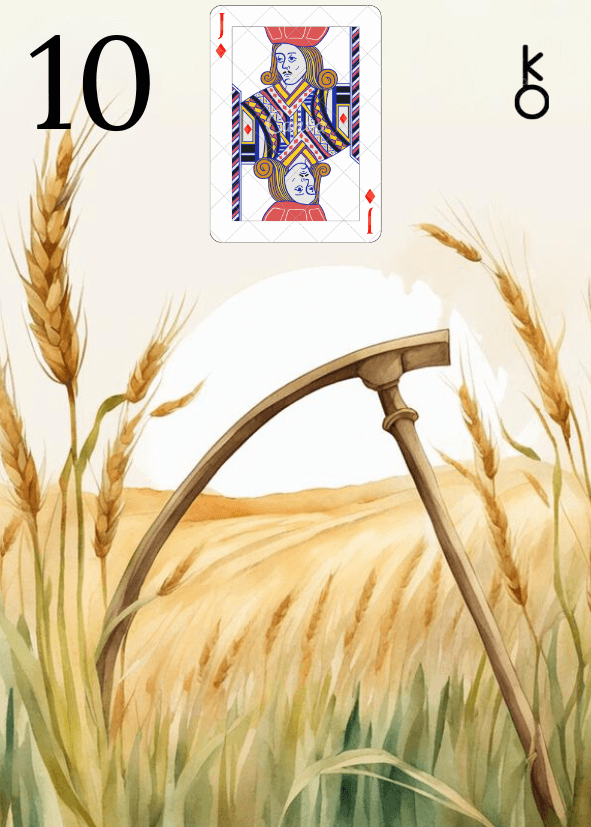
Lenormand card 10 Scythe
Quintessence

10 Scythe

The combination invites cutting through a habit that has become a source of permanent conflict.

breakthrough radical decision necessary restructuring
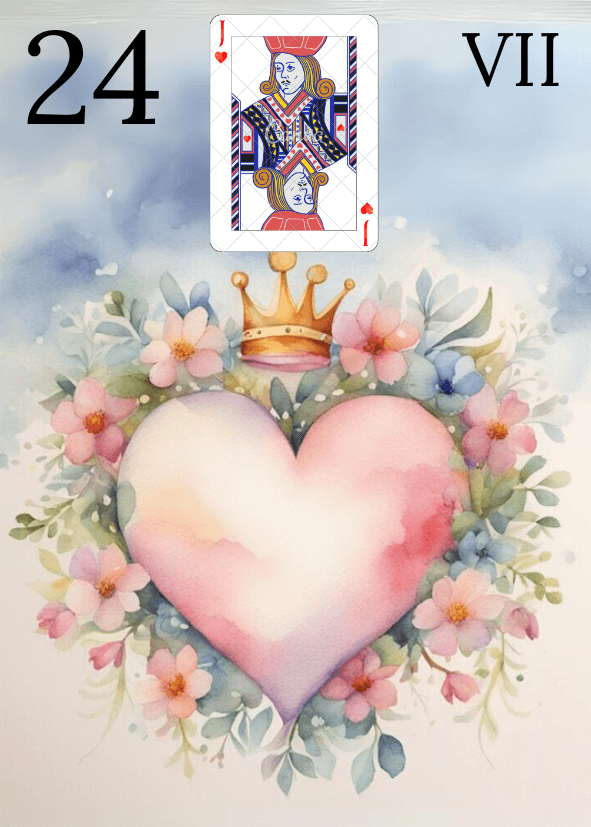
Lenormand card 24 Heart
Hidden card

24 Heart

At its core, it is the need to feel loved, recognized, and respected that fuels this agitation.

lack of appreciation emotional quest wounded loyalty