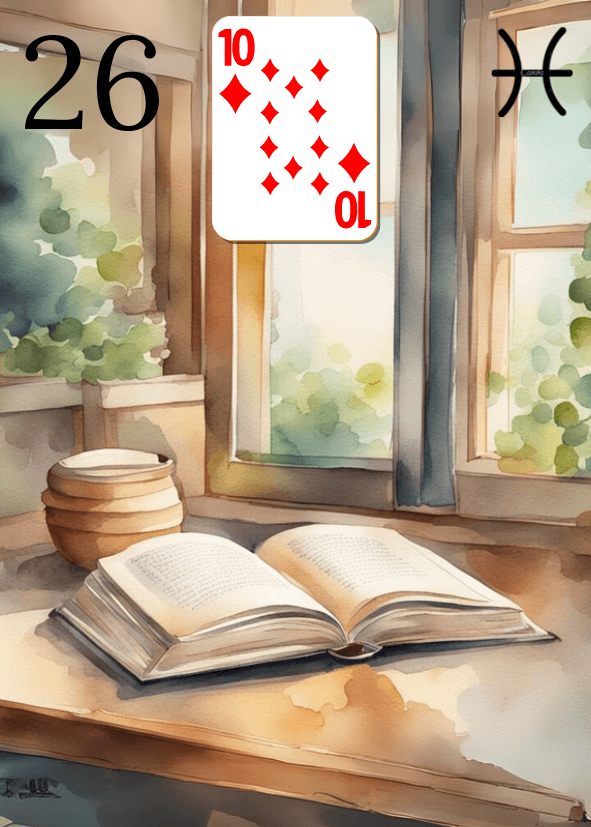
General meaning
⌄
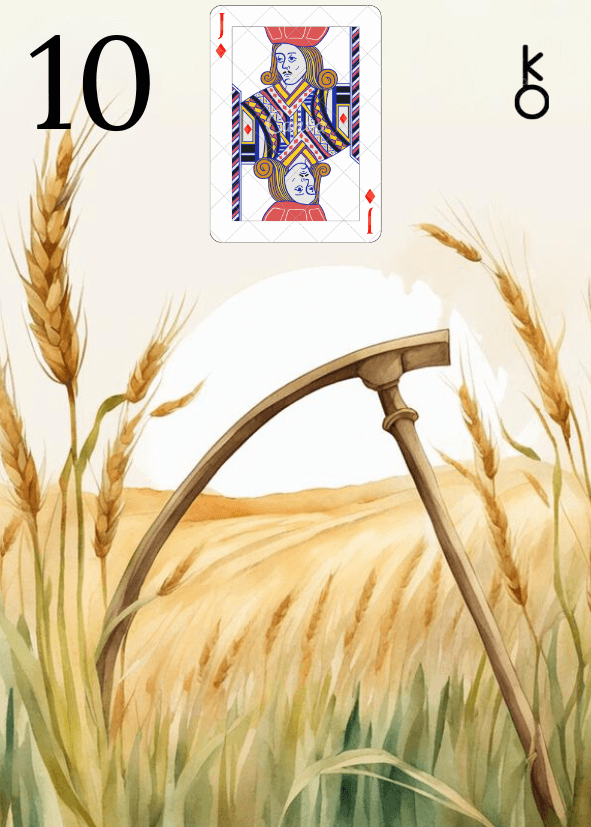
A scythe strikes down on knowledge, papers, or a secret contained in a book.
The Scythe, in the first position, indicates a quick action, a clear gesture, a moment when one cuts without turning back. With the Book in the second card, this gesture targets everything related to writing, information, archives, or things hidden in a file. It can involve revealing all at once what was concealed, but also destroying, redacting, masking, or censoring part of the truth. The combination often describes a decisive decision regarding studies, an exam, a research project, a manuscript, or a legal document. It is no longer the time to accumulate information: it is now about selecting, pruning, or even permanently closing an intellectual or administrative chapter.
Love and relationships
⌄
A truth written or revealed by messages comes to cut into the relationship.
On the romantic level, the Scythe coupled with the Book can translate the brutal discovery of a message, a history of conversations, or a diary that changes everything. One stumbles upon hidden exchanges, old correspondence, or intimate notes that reveal intentions or feelings that had been kept silent until now. The reaction can be immediate: cutting contact, ending the relationship, or demanding a straightforward clarification. In other cases, the combination speaks of a clear choice to stop documenting a past story, by ceasing to reread old messages or search social networks, in order to close the book and protect oneself.
Work and vocation
⌄
A file, training, or written procedure is abruptly stopped or deeply amputated.
In terms of work, the combination often emphasizes written documents: reports, archives, databases, internal procedures, technical documentation. The Scythe then announces a radical sorting, a deletion of files, an update that eliminates a whole range of obsolete information, or the decision to interrupt an ongoing study. It can also signal the abrupt end of a professional training, a long-prepared competition, or an editorial project related to work. The Book highlights that the matter at stake is intellectual or administrative, while the Scythe reminds us that decisions are made without hesitation in what seemed until then fixed or protected.
Money and material security
⌄
Financial or legal documents are cut, canceled, or withdrawn from circulation.
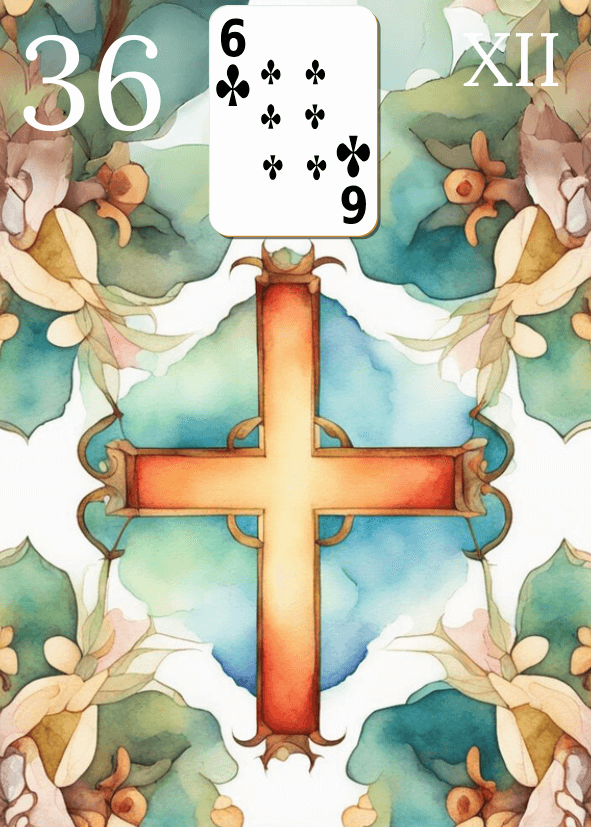
On a material level, the Scythe and the Book together can represent the cancellation of a contract, a notarized act, a banking commitment, or a written agreement concerning money. It may involve tearing up a document, having a clause annulled, contesting a written statement deemed abusive, or ending a procedure involving financial papers. This association also evokes radical sorting in statements, invoices, and receipts to start anew on a clearer basis. The Cross in essence reminds us that these decisions have a cost and leave a mark, even when the cut is necessary to end an administrative burden or an old mistake.
Health and energy
⌄
A decisive decision changes the way you document or follow a protocol.
For health, this combination can evoke the abrupt cessation of a treatment, therapy, or follow-up based on a written protocol. One decides to stop reading certain forums, to stop repeatedly consulting anxiety-inducing articles, or to end a medical wandering made up of successive exams that no longer bring clarity. The Scythe then symbolizes the act that cuts off endless searches and contradictory information, while the Book reminds us that the central question remains that of knowledge and understanding. This association invites sorting sources, accepting that not everything can be mastered by documentation, and trusting a simpler and more coherent framework.
Objects
⌄
Written or digital supports are at the heart of a radical gesture.
- Notebook, diary, or study notebook torn or thrown away to turn a page
- USB key, hard drive, or intentionally formatted digital folder
- Book, manual, or binder annotated and then set aside permanently or given away
Places
⌄
Certain spaces concentrate the moment when one cuts short a knowledge or a procedure.
Archive room, office where files are sorted, secretariat receiving a request for document destruction, media library where a book is permanently returned without being borrowed again, or even examination room where one decides to leave the test before the end: these places become the theater of a clear gesture regarding information. They symbolize the hinge between the accumulation of knowledge and the decision to put an end to an intellectual or administrative process.
Personality
⌄
A person chooses to close a book to preserve their integrity.
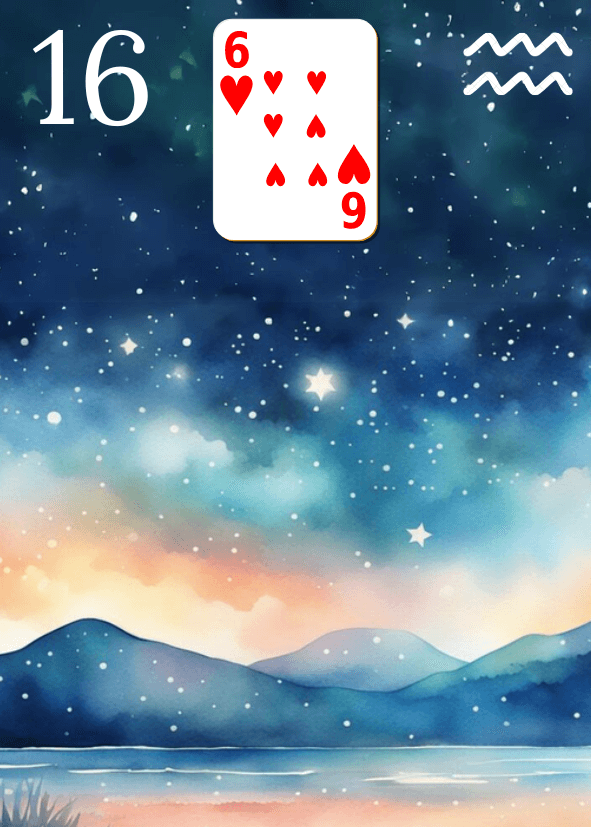
This combination can describe a profile that can no longer bear living in unspoken circumstances, with papers piling up or poorly digested secrets. The person decides to clean up: they sort, they delete, they cut access to certain content, they end a training or a writing project to no longer carry this burden. Their attitude may seem harsh or excessive, but it responds to a deep need for clarity and mental lightness. The Stars in the background show that a simpler and more aligned vision guides them, even if the Cross reminds us that this sorting comes with a form of trial or renunciation.
Profession
⌄
Professional roles are involved in sorting, censoring, or closing written files.
- Archivist, documentalist, or database manager conducting regulatory destructions
- Lawyer, attorney, or notary drafting acts of cancellation or revocation
- Publisher, proofreader, or collection manager making the decision to stop a publication project
Archetype
⌄
The page reaper who knows when a chapter must be closed.
The archetype associated with this combination embodies the moment when one stops adding lines to a story that no longer makes sense. Instead of continuing to accumulate information, notes, leads, and versions, they intervene to close the file, cut the excess data, and let the essential truth emerge. This character is not afraid to lose detail to gain coherence, even if the operation may be painful at the moment.
Shadow work
⌄
An impulsive destruction risks erasing valuable information.
In its dark aspect, the Scythe associated with the Book warns against a tendency to delete everything in a fit of emotion: erasing files, burning letters, tearing diplomas, or giving up a training for a single failure. One may also succumb to an impulse of censorship, hiding or truncating facts to avoid consequences. This attitude exposes one to future regrets when realizing that certain evidence, knowledge, or memories could have served as reference points in a more peaceful reconstruction.
Calibration questions
⌄
The way you manage writing and secrecy is at the heart of what is at stake.
- What document, writing project, or file are you clearly trying to eliminate from your life right now?
- What information kept under lock would need to be revealed to lighten a heavy situation?
- In your way of seeking information, when does the need to know become a source of tension rather than support?