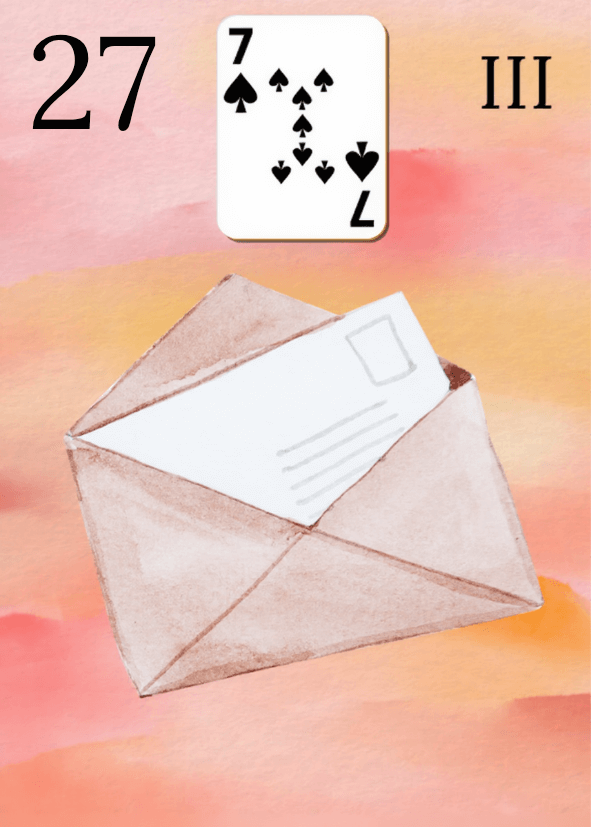
General meaning
⌄
An ending of a cycle takes shape through a written document, a message, or an official paper.
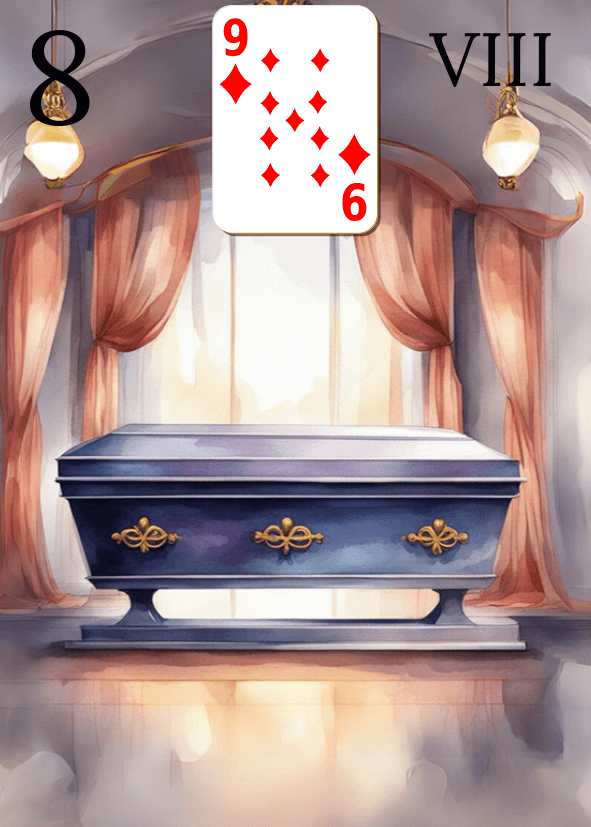
Coffin indicates that a situation is coming to an end, that an energy is withdrawing, and that it is no longer possible to continue as before. Placed in the second position, Letter materializes this ending in the form of an email, a letter, a text message, or any written medium. The combination speaks of a closure recorded in black and white: decision to put an end, confirmation of a halt, notification of blockage or suspension. It is no longer just a feeling of fatigue or weariness, but a clear announcement, sometimes cold, that seals the passage to something else.
Love and relationships
⌄
A relationship or an emotional phase ends with written words.
On the sentimental level, Coffin followed by Letter often evokes the famous 'breakup letter', whether handwritten, by message, or by email. A partner ends the relationship by choosing the distance of writing, or a story already moribund finally receives conclusive words. It can also refer to a period of official silence: no more responses, no more messages, a final text that marks the end of contact. Sometimes, it is you who writes these words to put a final point to a draining relationship. The combination invites you to observe what the writing comes to bury, but also what it allows to clarify for the future.
Work and vocation
⌄
A collaboration, a position, or a project is stopped and confirmed by letter.
In the professional field, this combination refers to formalized decisions: end of contract, dismissal, non-renewal, service closure, job elimination. Coffin shows the halt of activity, while Letter represents the document: official notification, HR email, registered mail, report announcing the end of a project. It may also concern a period of unemployment or imposed leave, documented in writing. Even if the atmosphere may seem heavy, this energy reminds us that a situation already at its breaking point finally finds its explicit conclusion.
Money and material security
⌄
Written decisions end a financial commitment or a material arrangement.
In terms of finances, Coffin and Letter together can speak of subscription cancellation, loan, lease, or insurance contract termination. One ends a commitment, sometimes by constraint, sometimes by choice. Notifications of account closure, end of rights, or cessation of coverage may also be at play. The combination also evokes sorting through old papers: one cancels, declares closed, destroys obsolete documents. The underlying question is whether this end allows for resource liberation, or if it imposes a more marked period of limitation.
Health and energy
⌄
A care or follow-up journey comes to an end and is materialized in a file.
In terms of health, Coffin followed by Letter can indicate the end of a treatment, care, or medical follow-up. Final reports, examination results, or discharge letters from hospitalization mark this closure. Sometimes, it also signals a sudden cessation of action: one decides to stop consulting, to discontinue therapy, and formalizes it by canceling appointments or breaking contact. The combination invites one to remain attentive to doctors' messages and not to bury an important subject too quickly under the pretext of having had enough.
Objects
⌄
Written documents make tangible what stops or concludes.
- Registered mail of cancellation, termination, or dismissal
- Final medical report, discharge letter, or end of treatment assessment
- Administrative document confirming the closure of a file or account
Places
⌄
Places where one comes to receive or send news of endings.
One might think of a post office, a mail service, an administrative counter, but also a medical or legal secretariat where one submits documents concluding a situation. It may also point to a place where you read your important emails, your office for example, where you receive announcements that mark turning points. These places concentrate the precise moment when the end becomes official.
Personality
⌄
Someone chooses to signify an end rather than let it linger.
This combination can describe a person who makes a decisive move by sending a clear message: they prefer a clean closure to a lingering ambiguity. They may appear cold or distant, but their intention is often to put an end to a situation that is already exhausted. In the shadow, this may be someone who cuts off in writing to avoid direct confrontation. In the light, it is also the figure of someone who finally dares to name what has long been over.
Profession
⌄
Professions where one formalizes endings in writing.
- Secretary or assistant responsible for sending closure or cancellation notifications
- Lawyer, notary, or attorney drafting acts of dissolution, termination, or end of procedure
- Administrative agent managing letters of end of rights, deregistration, or file closure
Archetype
⌄
The messenger of the last page.
This archetype embodies the precise moment when the end takes the form of a sentence, a paragraph, a signature. It articulates what can no longer last, so that reality aligns with the energetic state of things. Its role is not to please, but to clarify. It is the one who sends the message that was dreaded or awaited, and who opens, in the void, the possibility of a new chapter.
Shadow work
⌄
Remaining silent too long or ending with a hurtful written message.
In its shadow aspect, this combination can speak of brutal messages, sent coldly, that leave the other speechless. It can also reflect a sudden silence, a 'seen' without response that acts as a violent emotional closure. Out of fear of conflict, one chooses writing from a distance or total absence of words, which can create lasting wounds. The risk is to confuse a clean end with a hasty one.
Calibration questions
⌄
Can the words you write or receive make this end more just?
- What message have you recently received that clearly marked a before and after in a situation?
- What end of a relationship, contract, or project deserves a clear letter rather than a heavy silence?
- What words could you choose to close something with respect, even if it remains painful?