
General meaning
⌄
A commitment comes to an end and must be clearly acknowledged.
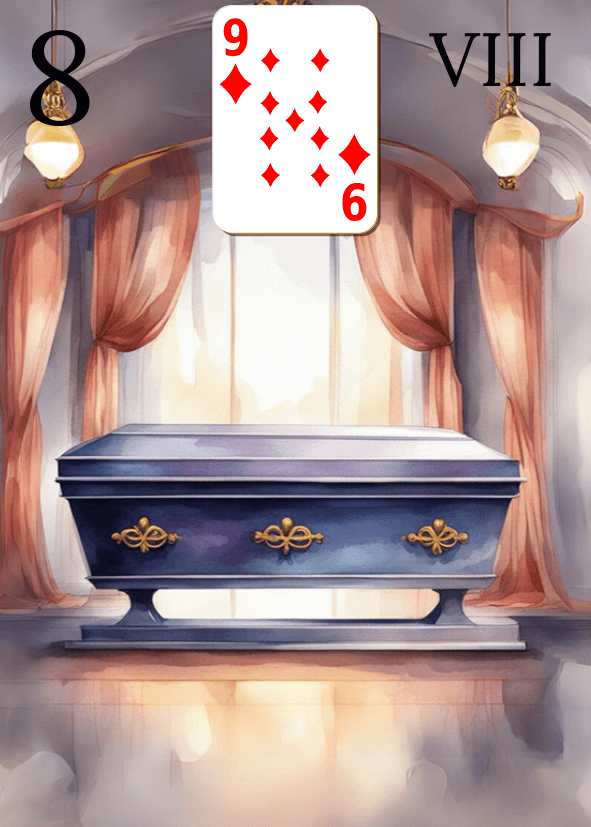
Coffin signals the definitive end of a cycle, the moment when continuing to honor a commitment would demand too much in terms of energy, time, or inner coherence. With Ring in the second position, it is a contract, an alliance, a promise, or an agreement that is at the heart of this closure. This combination describes the transition where one agrees to formally end something that was promised to be upheld, not out of whim, but because the current reality no longer permits it to be maintained without weakening. The end may be painful, but it also paves the way for a commitment that is more aligned with who you have become.
Love and relationships
⌄
A romantic relationship or commitment reaches its final point.
On the emotional level, Coffin and Ring together often refer to an official breakup: divorce, end of engagement, decision to terminate a stable relationship, or conclusion of a bond that is both secure and suffocating. This may signify the end of a promise of fidelity that can no longer be honored in practice, or the closure of a relational cycle where every effort has already been made. The combination underscores the irreversible nature of the decision: it is no longer about threatening to leave, but about actually signing the end of a joint commitment.
Work and vocation
⌄
A professional contract concludes and marks the end of a chapter.
In the realm of work, Coffin followed by Ring can indicate the termination of an employment contract, a collaboration, an association, or a mandate that is no longer relevant. You may find yourself agreeing to a mutual termination, not renewing a fixed-term contract, or ending a partnership with a client or associate. Sometimes, the situation was already deteriorating in practice: no more motivation, trust, or results. The combination encourages you not to artificially prolong what no longer functions, even if the signing of the end remains a charged moment.
Money and material security
⌄
A financial obligation comes to an end or must be halted.
Financially, this association can refer to the closure of a loan, the end of a lease, or a monetary commitment that was holding you back. It can also indicate the cessation of an unbalanced financial agreement, where you were contributing more than you were receiving in return. It may sometimes involve settling a debt, a pension, or an obligation that you have been carrying for a long time. The message is not so much about loss as it is about liberation: accepting the end of a contractual framework to reassess your approach to engaging with money.
Health and energy
⌄
The body demands the cessation of a rhythm or a burdensome commitment.
In terms of health, Coffin and Ring can reveal a commitment that has become too heavy for your body: intense hours, continuous responsibilities, constant availability. A work stoppage, a forced break, or the end of a commitment that was exhausting you may become necessary. It may involve breaking a contract or a professional rhythm to safeguard your health, even if the decision seems drastic. The combination emphasizes that your body can no longer be bound by the same promises as before.
Objects
⌄
Documents or symbols materialize the rupture of the commitment.
- Employment or rental contract signed for termination or non-renewal
- Divorce decree, separation agreement, or official judgment
- Cancellation file for subscription, partnership, or service
Places
⌄
Spaces signify the scene of the end of an agreement.
One might envision a notary's office, human resources, mediation, or a court where one comes to sign the conclusion of a commitment. It can also represent a professional space, a shop, or a workplace that is being emptied and returned, akin to a life setting that is left after having honored a contract for an extended period.
Personality
⌄
A person chooses to break a commitment rather than betray themselves.
This energy describes someone who has long kept their word, sometimes beyond reason, and who realizes that it is no longer feasible to continue under the same conditions. They can be very loyal, but out of fidelity to themselves, they ultimately decide to stop. The choice to break the commitment does not stem from capricious instability, but from a realization: this contract is no longer viable for either party, or is no longer compatible with their health, values, or evolution.
Profession
⌄
Roles specialized in the conclusion or renegotiation of commitments.
- Lawyer or attorney specializing in contract or labor law
- Mediator focused on amicable separations
- Advisor in career transition or outplacement following contract termination
Archetype
⌄
The closer of commitments that have expired.
The archetype at play is one who dares to act on the administrative, symbolic, or energetic conclusion of a commitment that has already given all it could. They do not seek to destroy for the sake of breaking, but to acknowledge that a cycle has ended. This figure accepts to take on the final signature, this concrete gesture that formalizes what life has already been indicating for a long time.
Shadow work
⌄
Burning all bridges without taking the time to understand what is at stake.
In its shadow, this combination can lead to a harsh break without dialogue or clarification, stemming from weariness, anger, or the desire to stop everything abruptly. One risks repeating the same scenario elsewhere, in another commitment, without having learned the lessons of what led to the end. The temptation is to view the commitment as a prison rather than as a framework to adjust or leave consciously.
Calibration questions
⌄
The end of this commitment can become a significant turning point if you fully embrace it.
- What commitment are you reaching the end of your strength to maintain today?
- What are you still trying to prolong when everything indicates that the cycle is over?
- In what way could you conclude this story without denying the values that initially motivated you to commit?