General meaning
⌄
The living environment becomes rigid and gives the impression of being stuck behind an invisible wall.
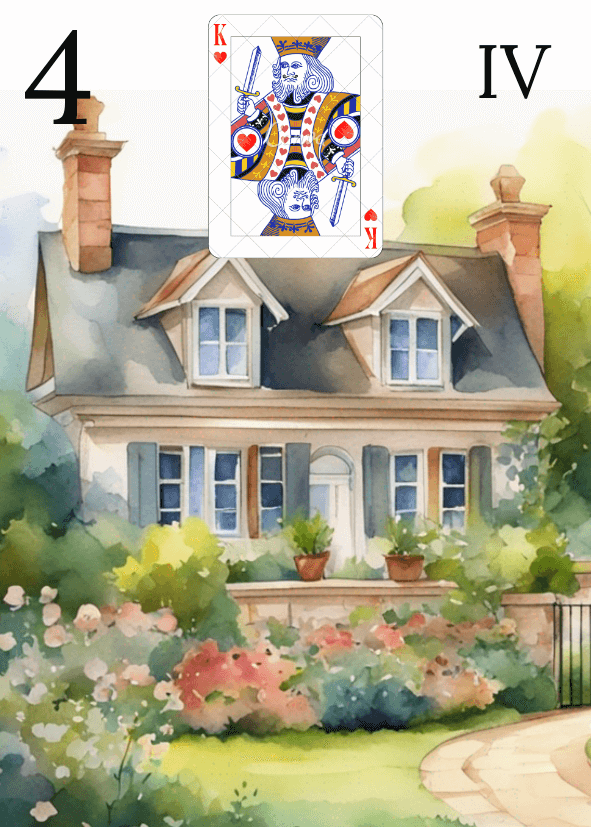
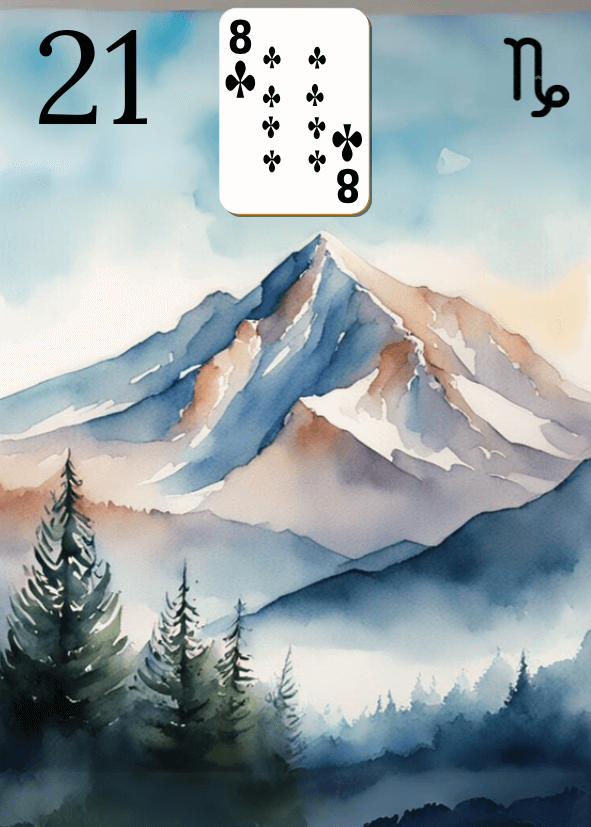
The House symbolizes home, intimacy, family, but also security and territory. The Mountain represents enduring obstacles, coldness, and challenging barriers to overcome. Together, these cards suggest an environment that provides reassurance in some aspects while also conveying a sense of confinement or hindrance in one's evolution. It may be a home that has become too burdensome to manage, a rigid family context, or a living space that no longer allows for new horizons to open. The combination invites you to honestly assess what, in the current setting, still supports your stability and what, conversely, contributes to your stagnation.
Love and relationships
⌄
Couple or family life unfolds in a climate that is more frozen than genuinely warm.
On the sentimental level, the House and the Mountain can describe a settled couple facing stubborn blockages: stifling routine, taboo subjects, old resentments, lack of dialogue or flexibility. The home remains in place, but the atmosphere can be cold, distant, sometimes marked by a feeling of a wall between individuals. In some cases, the family of origin or the domestic context exerts pressure that prevents the relationship from evolving freely. The question then becomes: what needs to be softened or moved, inside or outside the house, for the heart to breathe again?
Work and vocation
⌄
The professional sphere and domestic life intertwine in a framework that limits maneuverability.
In professional life, House can represent working from home, a family business, a fixed office, or a sedentary position. Mountain adds the idea of heaviness, a difficult load to move, or hierarchical or structural blockage. The combination may indicate an activity stuck within the walls of the home, difficulties in finding a balance between private and professional life, or a family business frozen in its habits. It suggests that the desire to evolve clashes with forms of rigidity: entrenched habits, family rules, real estate or organizational constraints.
Money and material security
⌄
Material concerns related to housing or family weigh heavily on the margin for movement.
For financial matters, House and Mountain can illustrate a heavy real estate burden (loan, high rent, costly renovations), significant family expenses, or a very constrained material context that blocks certain projects. One may feel obliged to remain in a situation out of concern for security or attachment to the place, even as financial pressure increases. The combination invites a reevaluation of the relationship between the need to feel secure and the price to pay, in time, energy, and money, to maintain this framework at all costs.
Health and energy
⌄
The body and well-being suffer from a lifestyle that is too compartmentalized or too sedentary.
In terms of health, House can evoke the cocoon, rest, the need for protection, while Mountain refers to heaviness, slowness, and sometimes a form of physical or psychological rigidity. The combination may describe forced sedentariness, isolation that weighs on morale, or a tense domestic climate that adds stress to an already fatigued body. It suggests revisiting how you use your living space: does it truly protect your vitality, or does it contribute to making it more inert?
Objects
⌄
Household objects serve as reminders of an anchoring that has become difficult to evolve.
- Mortgage files, heavy leases or rental contracts
- Massive or bulky furniture symbolizing a setup that is difficult to move
- Security systems or protective devices reinforcing the feeling of barricading oneself
Places
⌄
Certain places are experienced both as a refuge and as a fortress.
This may involve an isolated family home, an apartment in a massive building, a secluded village, or a difficult-to-access neighborhood. These places provide a sense of stability but can also reinforce the impression of being cut off from the rest of the world. The combination highlights this paradox: the same roof can offer warmth or confinement, depending on how one experiences it and moves within it.
Personality
⌄
A protective temperament seeks security, sometimes at the cost of a certain closure.
This combination may describe someone very attached to their home, their habits, their clan, who needs stable references to feel good. However, this desire to protect loved ones can transform into rigidity, excessive control, or fear of embracing the new. The person may be difficult to approach or to convince to change their framework. The challenge is to honor this need for stability while accepting to open certain windows, even just a little.
Profession
⌄
Roles associated with managing places, structures, or households that are difficult to move.
- Management of real estate, residences, estates, or family structures
- Roles related to the security of buildings or living spaces
- Professional activities carried out in a fixed framework where changes are rare and difficult to implement
Archetype
⌄
The house-fortress.
This archetype embodies a place that protects but has thickened its walls so much that it allows in few new things. It reminds us that a home can be a haven or a prison, depending on the flexibility of those who inhabit it. Its wisdom lies in recognizing the moment when it becomes necessary to loosen the locks, rearrange the inside, or dare to look beyond the mountains visible from the windows.
Shadow work
⌄
Security transforms into confinement when one refuses any movement under the pretext of stability.
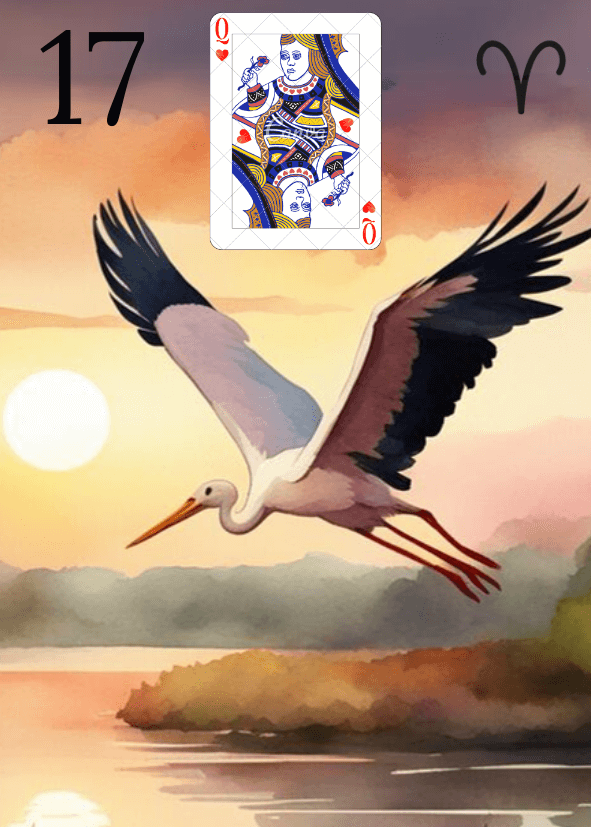
In its shadow, the combination points to the risk of being stuck in a situation solely because it is familiar: house, family, inheritance, coasts, or domestic rules. One may convince oneself that it is impossible to move, relocate, or reorganize, while certain choices would be feasible, even if they require courage. The danger is to make House an excuse for never responding to the call of Stork deeply.
Calibration questions
⌄
Does your need for security still protect your life, or does it freeze it behind walls that are too thick?
- To what extent does your current living environment truly support you, and where does it seem to hold you back?
- What small adaptations could you consider to lighten the weight of domestic constraints?
- If you allowed yourself to imagine another place or another way of living, what would it look like?